
Metro Transit
Public transportation in the Twin Cities (Minnesota)

For a while now, I have been noticing how empty Metro Transit buses are. I live by the Southwest Light Rail (AKA Green Line) construction, and my running joke is that I want to ride the Green Line from my home to a Twins game before I die.1 Although I was a regular bus rider from first grade to my mid-30s, I have grown cynical about the viability of the Twin Cities’ public transit. I have often wondered if it would be cheaper to provide public transit riders (who have financial need) with free ride-share vouchers than maintain the Metro Transit.2
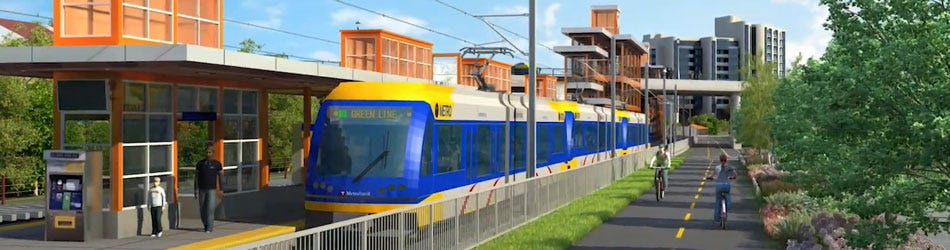
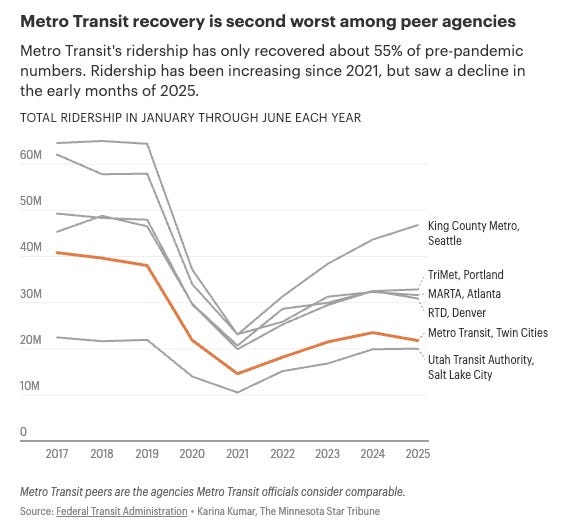
I am thinking about the Metro Transit because of a recent Star Tribune headline: “Twin Cities transit ridership still struggling post-pandemic, lags behind most big cities.”
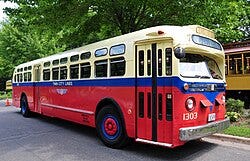
When I was entering first grade, my mom taught me how to ride the bus to school; at the time, public transportation was run by a private company: Twin City Lines. We lived in an apartment just off Lake Street on Dean Parkway (at the time it was Dean Boulevard), and I went to school at Basilica of St. Mary’s near downtown. I took the number 12 bus, which went from Hopkins to downtown Minneapolis. My mom went with me on the first day of school in September of 1965, and then was there at the bus stop at the corner of Hennepin and 16th Street North after school that first day to show me the way home - and that was that - I was an independent bus commuter.
Bus ridership in the Twin Cities was already in decline when I started riding in 1965. Buses began replacing streetcars in 1949, and the transition was complete by 1954. Buses were considered more flexible to meet changing traffic patterns as urban sprawled into suburban. The automobile had changed the game, making people more mobile and destroying the need for downtowns and transit corridors. The Twin Cities Lines was in financial trouble in the mid-1960s. A bus company was no longer a financially viable business in the Twin Cities and across the U.S. President Johnson saw public transportation as a necessity for poor people. So he included federal funding for public transportation as part of his huge “War on Poverty” welfare program.
In the Twin Cities, the Metropolitan Transit Commission (MTC)3 was formed in the late 60s, and the Twin Cities Lines were purchased, resulting in socialized public transportation that was and continues to be funded by fares (25% today), state and federal funds, and local property taxes. The goal was to provide mobility to the urban poor and not to compete with automobiles.
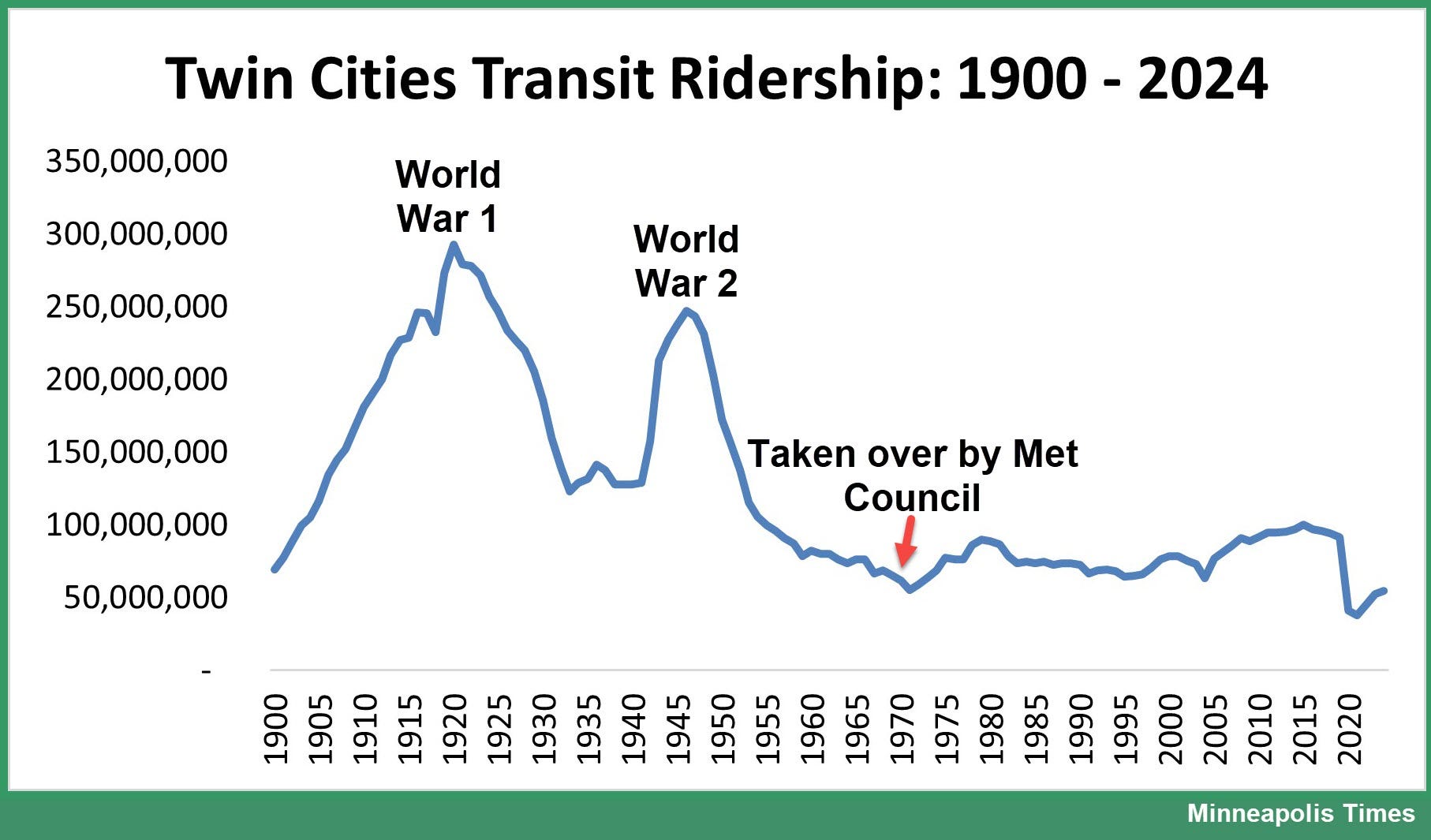
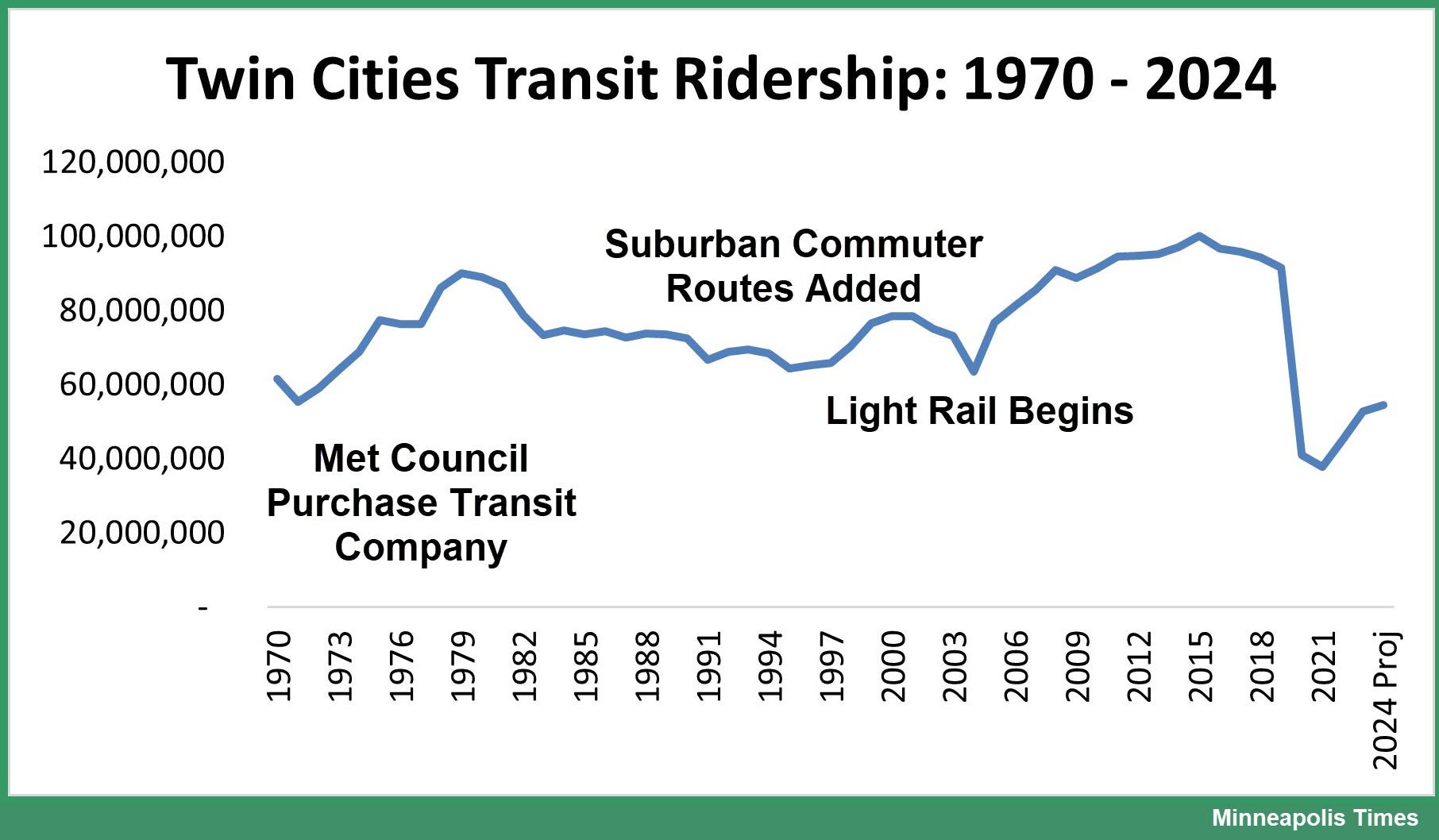
By the early 1980s, traffic congestion was a big problem, and public transportation was seen as part of the solution. Metro Transit developed commuter bus routes to take people from the suburbs to the downtowns. Primary ridership transitioned from the urban poor to more affluent suburbanites who worked downtown. Ridership spiked up, but nothing close to pre-World War I.
Metro Transit had a vision of replacing the suburban commuter buses with light rail, and in 2004, Hiawatha Light Rail opened to bring suburban commuters into downtown. It created a temporary boost in ridership (again, nothing close to the pre-WWI era). Then COVID devastated ridership, and Metro Transit has not recovered.
We still have transportation issues:
Poor, disabled, and elderly people need alternative transportation to cars
Traffic congestion has returned after a pause during COVID-19, and is further aggravated by public transportation and bike lanes
Climate change - a bus passenger emits about 40% less carbon than a single passenger in a gas-powered automobile; however, hybrids and fully EV automobiles are eliminating that advantage
Public transportation only works when land use supports it (think of New York City and its subways). Before the automobile, Twin Cities’ land use, such as retail and office use, followed the streetcar lines. Post-automobile, urban/suburban sprawl has been the winner. Transportation corridors have lost thier relevance. COVID created a temporary disruption, cutting public transit ridership in half. Post-COVID appears to have made a permanent new issue: odd traffic patterns caused by full and partial remote workers, coupled with the slow death of brick-and-mortar retail, thus Metro Transit ridership is not recovering to pre-COVID highs.
Urban elected officials and government bureaucrats pine for the urban density of pre-WWI, with plans like Minneapolis 2040 that would create land use that is conducive to traditional public transit corridors served by buses and light rail. The public is not buying it.
I feel like it is time to consider giving up on buses and light rail and seriously consider alternatives. Metro Transit’s Network Now plan seems delusional.
An idea that I think has merit is Autonomous EVs:
They can go anywhere
If subsidized, they could provide for the transportation needs of the poor and elderly
Public and private companies are investing4
Their appeal is beyond people who can’t afford a car
They are green
They would be “smart” enough to minimize traffic congestion, and dynamic pricing could incentivize trips during non-peak times
They would not be any more expensive (and perhaps less expensive) than what we have now
We will still need something like Metro Mobility for people with disabilities whose needs are more than just a ride, but that is a small enough population to be manageable.
The Green Line $3 billion fiasco was first approved in 2010, and construction started in December 2018. The trains are expected to be running by 2027. I assume they will be underutilized.
Carol Becker, in her three-part series on Twin Cities public transit in the Minneapolis Times, estimates that each Metro Transit ride costs $20 - that does not even include the $3 billion capital investment in the Green Line.
The MTC eventually evolved into the Metropolitan Council (AKA Met Council), which is an unelected governing body (commissioners selected by the Minnesota Governor) with broad powers in the Twin Cities seven-county metro area.
Major players in the autonomous EV space include: Waymo (Alphabet's self-driving unit), Tesla, Cruise (General Motors), and Zoox (Amazon), which are developing fully autonomous systems and ride-hailing services. Other notable companies include Aurora, Pony.ai, and those integrating autonomous tech into their vehicles, such as BMW, Mercedes-Benz, and Volkswagen.