
The METRO E Line (Minneapolis)
Is the newest BRT route, which replaced one of the most used conventional METRO bus routes, a success? YES!

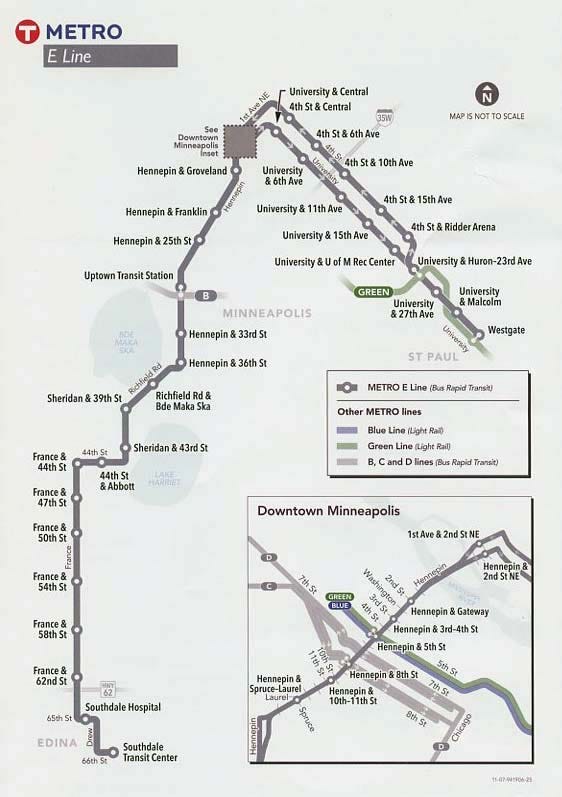
The E Line, the Twin Cities Metro Transit’s (METRO) latest BRT (Bus Rapid Transit) service, came online on December 6, 2025. METRO is bragging (I have seen several news stories from different media outlets, so METRO’s PR machine is working) that the route is averaging about 5,600 rides a day1 - twice the number they expected. METRO has 8 BRT lines in service and several more lines planned.
Despite being a loyal METRO rider for about half my life, I started this post as a public transit skeptic for our area (Minnesota’s Twin Cities) because I didn’t think we were getting value from METRO. I feel like it is time to consider giving up on buses and light rail and seriously consider alternatives like subsidized autonomous EVs for public transit.
The E Line is a 13.3-mile route from the Southdale Transit Center in Edina to the Stadium Village Station at the U of M. It covers some key Minneapolis travel segments:
Southdale to 50th & France
50th & France to Uptown
Downtown to U of M
U of M to Stadium Village
The E Line replaced the former Route 6, which carried 8,000 to 9,000 daily riders before being replaced by the E Line (Route 6 had 10,000 to 12,000 daily riders in its heyday in the late 90s). It is estimated that 18,000 to 25,000 people are moved by 18,000 to 22,000 cars through this same corridor, compared to the 5,600 riders of the 10 to 12 E Line buses. The former Route 6 line needed 25 to 30 buses to service the route. The operating cost of the E Line is lower than that of Route 6, which it replaced, because it has fewer buses. So it appears the E Line is pretty efficient.
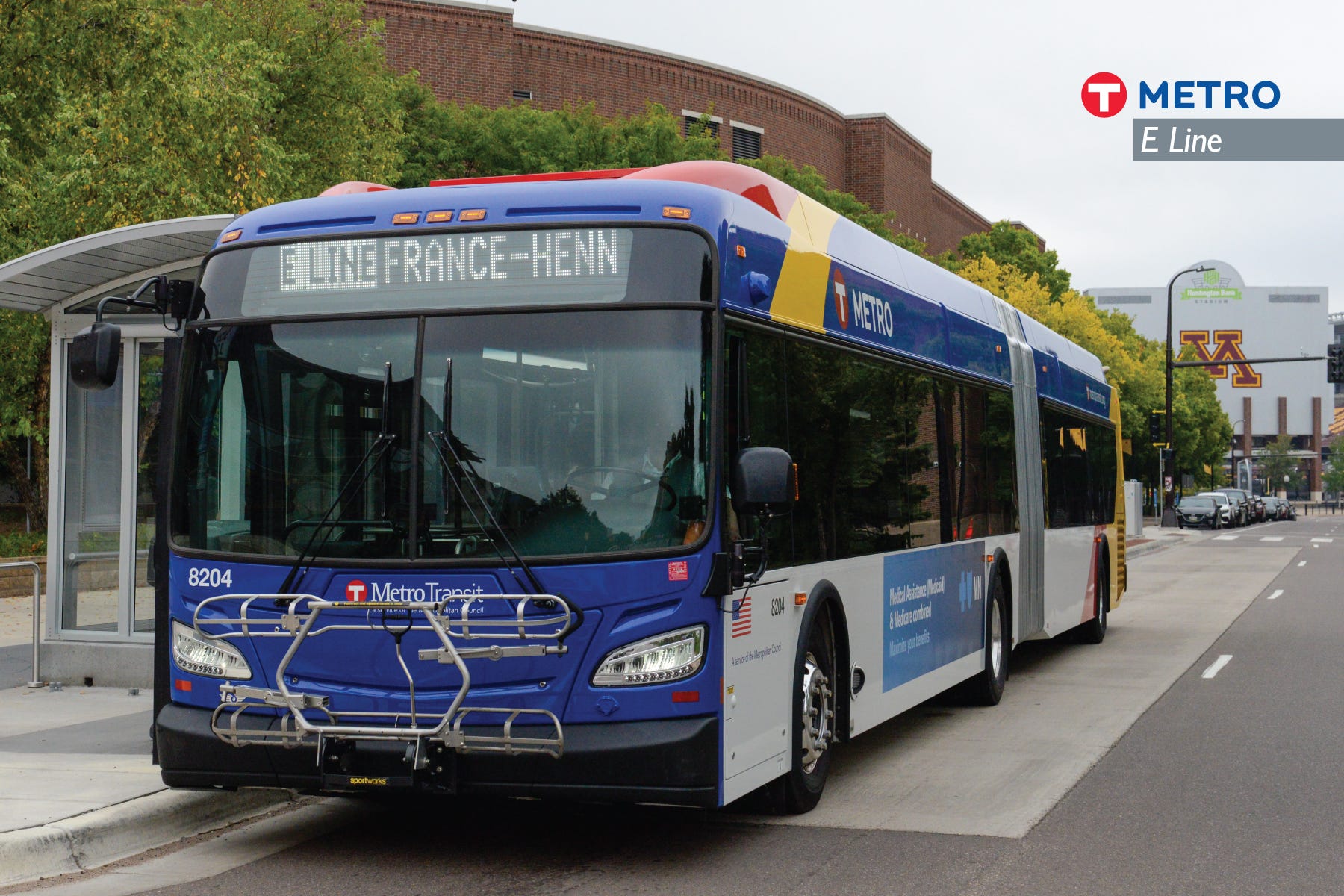
The idea of BRT is to bring speed and reliability to buses. The Route 6 stopped every 1 to 2 blocks, and the E Line stopped every 1/4 to 1/2 mile, so getting from point A to point B is faster with BRT vs. a conventional bus. Plus, the 10-minute frequency makes it a more reliable service. Overall, the operating cost and emissions per rider are lower than those of conventional buses and cars. BRT uses 60-foot articulated buses that carry twice as many passengers as conventional buses. Most BRT routes do not use dedicated bus lanes, including the E Line. The E Line mostly uses mixed-traffic lanes, except for a few small priority segments.
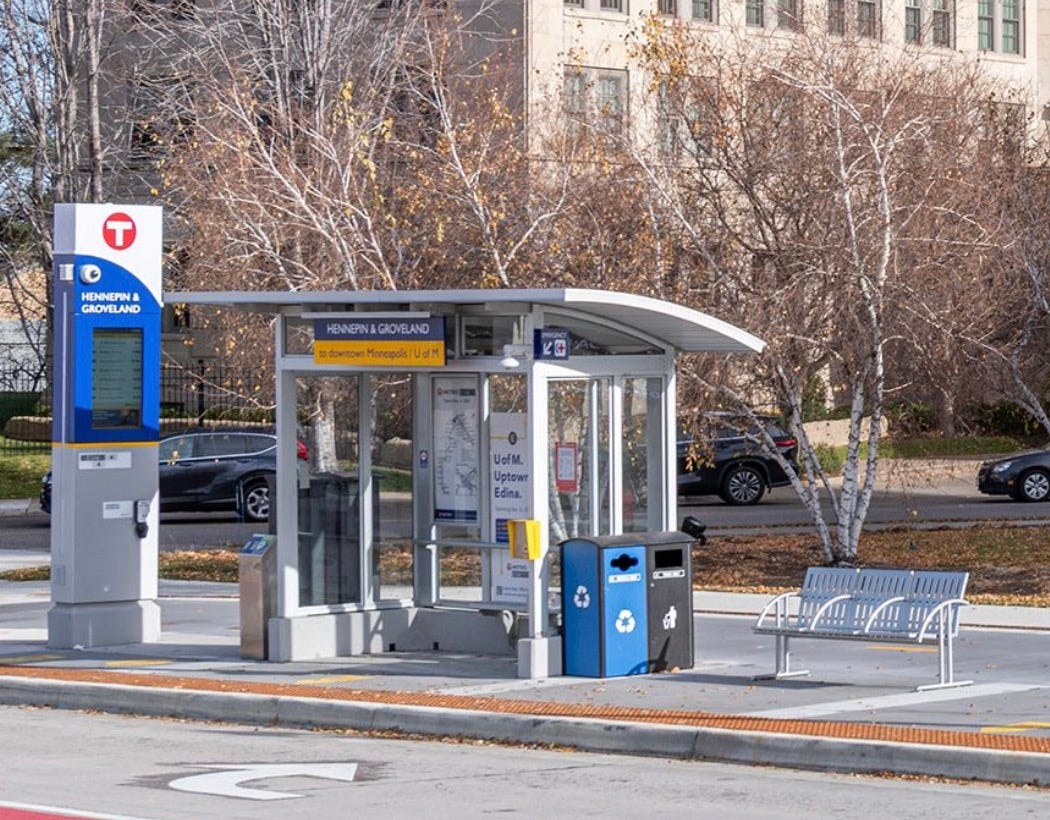
BRT also has stations with shelter, heat, information, and self-service fare machines.
The cost of implementing the E Line was $64 million,2 and the annual cost is estimated at $9-$11 million. So, assume the $64 million is a fixed asset with a 10-year life, and the annual cost of the E Line is $17 million. That translates into $8.32 a ride. Public transit, like regular buses, BRT, and light rail, is subsidized in that fares don’t cover the cost of the ride (the E Line fare is $2 for non-rush hours and $2.50 for rush hours). Car and truck drivers cover only about half the cost of roads (through things like gas taxes), and the rest comes from general taxes. Keep in mind the average daily cost of a consumer driving a car is about $32 per AAA. The current BRT system is underutilized, and ridership were to reach capacity, it would nearly break even.
Although it appears that the E Line has not fully achieved the ridership of the old Route 6, it should be noted that the E Line replaced only part of Route 6. There are also new Route 36 and Route 6 Local lines that represent the rest of the old Route 6. This explains the 2,000 to 3,000 daily riders that Route 6 had but that the E-Line doesn’t. It appears that between the E Line and Routes 35 and 6 Local, the old Route 6 corridor now has slightly more bus riders.
So is the E Line a success? I would say yes.
Riders are adopting it
It is less costly per rider than the Route 6 it replaced
It is faster than the Route 6 it replaced (depending on the segment 10% to 20% faster)
It has lower emissions per rider than the Route 6 it replaced
It appears to be attracting new riders, not just old Route 6 riders
The BRT solution appears to be an upgrade from conventional buses and bus routes
The BRT solution appears to be a more economical solution than light rail
I am not sure what it will take to increase ridership even more, as most people prefer to travel by car, even though it is more expensive (and, depending on where you are going, a hassle to park). After researching and writing this blog post, I am less skeptical about METRO than I was when I started. I still think we should be exploring subsidized autonomous EVs as the future of public transit. A city needs public transit for citizens who can’t afford a car. I believe that, in the long term, for economic, safety, and climate reasons, we need to move away from human-driven, internal-combustion cars. I am not a transit expert, just a skeptical citizen who hasn’t used METRO since the mid-90s. After writing this post, I am committed to trying BRT routes and seeing whether they are a viable option for some of my trips.
There are about 150 runs a day, so the 5,600 trips suggest 37 passengers per run over 13 miles. Metro Transit does not publish route usage by hour, but it is estimated that the morning and evening rush hours account for about 50% of ridership, and midday for about 30%. The E-Line runs nearly around the clock.
The $64 million included 34 stations, the buses, and roadway enhancements.
I love the E bus line. I take it to Uptown and through downtown. I hope to take it to Southdale soon.
It often also has metro officers on the bus which improves the overall experience.
Thanks for this excellent research.